
Our Services
Auditory Processing
We help children who can hear but struggle to make sense of what they hear. When the brain has difficulty processing sound, everything — from school to friendships — becomes harder.
What is auditory processing?
Auditory processing is what the brain does with the sounds the ear picks up. When there’s a breakdown in that process, it’s called an Auditory Processing Disorder (APD). Children with APD typically have normal hearing — the challenge isn’t with the ear itself, but with how the brain interprets and organizes sound.
Standard hearing tests won’t detect APD. Specialized testing is needed to understand how your child’s brain processes what they hear.
Signs to Watch For
Is this what you’re seeing?
Frequently says “what?” or asks you to repeat things
Struggles to understand speech in noisy places — like a classroom or restaurant
Has trouble following multi-step directions
Confuses similar-sounding words (like “shoulder” and “soldier”)
Seems to “tune out” or daydream, especially during conversations or instructions
Has difficulty with reading, spelling, or sounding out words
Gets exhausted from sustained listening
Has been considered for an ADHD diagnosis — APD is frequently misidentified as ADHD
You might notice your child:
What we assess
We offer multiple levels of assessment to meet your family’s needs:
Screening: A targeted screening paired with an intake questionnaire to explore multiple areas and determine which formal assessments make sense. This is both cost-effective and time-efficient.
Comprehensive evaluation: A thorough formal assessment that produces a detailed report with clear recommendations and a plan for intervention.
Our screening tools help differentiate between APD, attention difficulties (ADD/ADHD), specific learning disorders like dyslexia, and language processing challenges. Assessments are available for children as young as age 3.
What the process looks like
Every child’s assessment is different, but you can generally expect:
- Initial conversation — We talk with you about your concerns and your child’s history
- Screening or intake — We determine which formal assessments are appropriate
- Testing — Your child completes age-appropriate listening tasks in a comfortable environment
- Results and recommendations — We explain what we found and map out next steps together
How we help
Once we understand your child’s processing profile, we create a personalized plan that may include:
Clinical therapy: One-on-one sessions targeting specific auditory skills — including phonemic awareness, listening in noise, sound discrimination, pitch pattern recognition, and auditory memory training.
Strategies for home and school: Practical adjustments like reducing background noise, using visual supports, pre-teaching new vocabulary, building in listening breaks, and creating better acoustic environments.
Technology supports: When appropriate, we may recommend FM systems, assistive listening devices, or other tools to support your child’s listening in challenging environments.
Why this matters
When a child struggles to process what they hear, it affects everything — their ability to learn, to connect with others, and to feel confident. But when a child begins to understand what they hear clearly, everything changes. School gets easier. Friendships deepen. Frustration fades.
We’re here to help your child get there.
Common Questions
Frequently asked questions
What is the difference between APD and a hearing problem?
Children with APD typically pass standard hearing tests. Their ears pick up sound normally, but their brain has difficulty interpreting and organizing what they hear — especially in noisy environments or when instructions are complex.
At what age can a child be tested for auditory processing disorder?
We can begin screening children as young as age 3. Comprehensive formal testing is typically most reliable from age 7 onward, though earlier screening helps identify concerns and start supportive strategies sooner.
Is auditory processing disorder the same as ADHD?
No, but they are frequently confused. Children with APD may appear inattentive because they struggle to process what they hear — not because they can’t focus. Our assessments are designed to help distinguish between the two.
How long does an auditory processing assessment take?
A screening typically takes about 60 to 90 minutes. A comprehensive evaluation may require two to three hours, sometimes spread across two appointments to keep your child comfortable.
Will my child need therapy after the assessment?
It depends on the results. Some children benefit from direct therapy, while others do well with classroom accommodations and home strategies. We’ll discuss all the options with you and help you decide what’s right for your child.
Does insurance cover auditory processing assessments?
Many extended health benefit plans cover audiology and speech-language pathology services. We recommend checking with your insurance provider. We can provide receipts with the appropriate professional designations for reimbursement.
APD the Brain and Central Nervous System
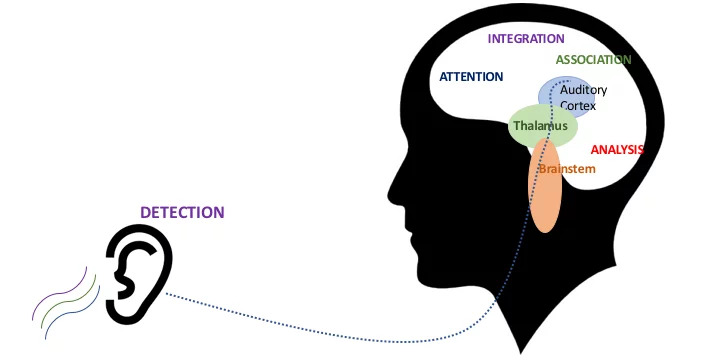
Auditory processing disorder (APD) is a term for a variety of disorders that affect the way the brain processes auditory information. Individuals with APD usually have normal structure and function of the outer, middle, and inner ear (peripheral hearing). However, they cannot process the information they hear in the same way as others do, which leads to difficulties in recognizing and interpreting sounds, especially the sounds composing speech. These difficulties arise from dysfunction in the central nervous system.
It can affect both children and adults. Cooper and Gates (1991) estimated the prevalence of adult APD to be 10 to 20%. It has been reported that males are twice as likely to be affected by the disorder as females, and that prevalence is higher in the elderly and increases with age.
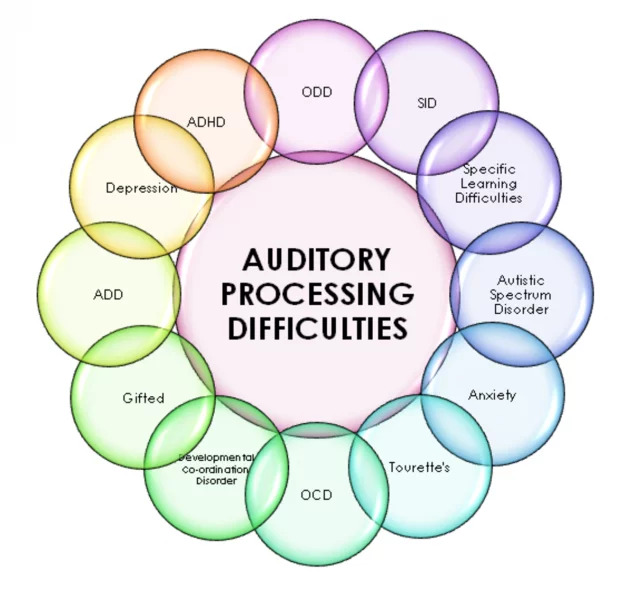
APD can be associated with other diagnoses.
Intervention for APD
There are 3 broad categories for intervention:
Language & Compensatory Strategies
- Reduce background noise
- Acoustic modifications (carpet, curtains, bookcases)
- Note-taking aid
- Attention prompts and cueing
- Eye Contact
- Comprehension checks
- Visual aids
- Listening breaks
- Pre-teaching of new concepts & vocabulary
Intervention/Treatment
- Auditory skills training
- One-on-one therapy with a clinician
- Phoneme discrimination
- Listening in noise training
- Pitch pattern awareness
- Temporal resolution training
- Binaural integration training
- Localization/lateralization of sound
- Dichotic listening training – amblyaydia
- ‘Ear advantage’ training
Amplification/Technology
- Personal FM system
- Soundfield system
- Low-gain hearing aids (LGHAs)
- Assistive listening devices
- Laptop/tablet with word processing capabilites
- Custom ear filters and noise cancelling ear pieces
Support System
Support groups – both online and in person – can help parents and adults connect with people who are experiencing similar difficulties and give ideas of treatment or accommodations that have helped. Feel free to join our social media page on Facebook in order to collaborate with others experiencing APD.
www.facebook.com/groups/apdcanada/
Explore More